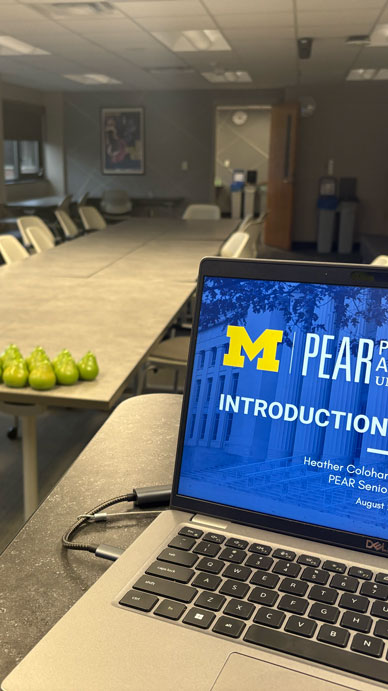
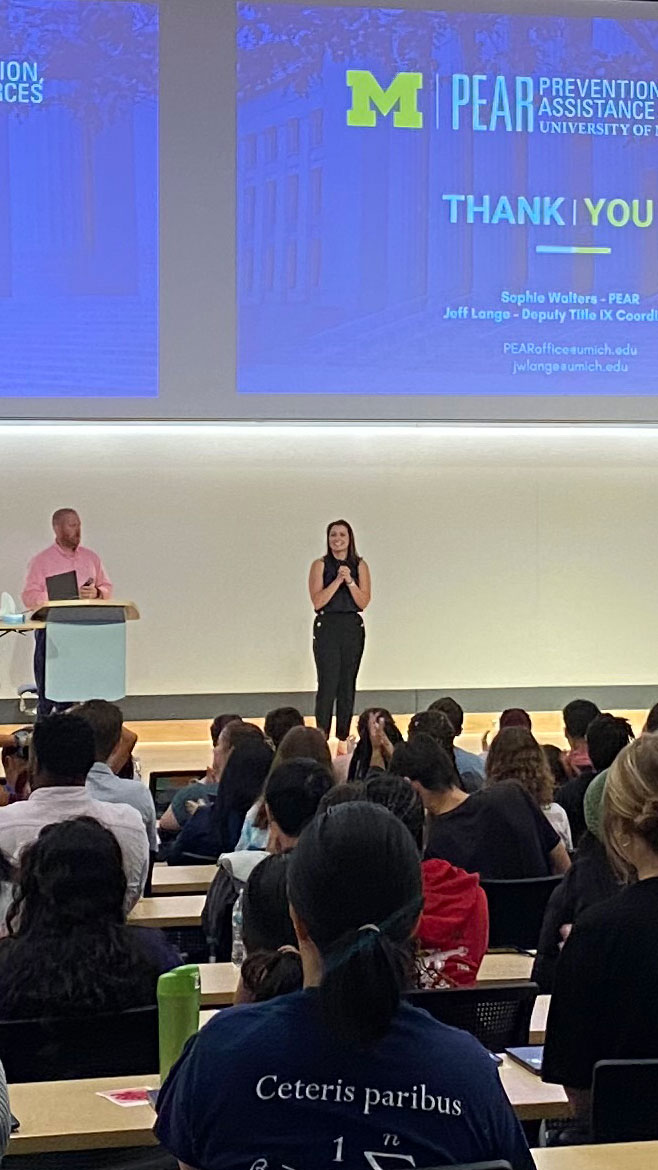
The PEAR team provides presentations, workshops, professional development, and resources for the prevention of sexual and gender-based misconduct for employees across U-M’s Ann Arbor, Flint, and Dearborn campuses, and Michigan Medicine. We also consult with faculty and staff leaders to support units in holistically responding to sexual and gender-based misconduct within their communities.
PEAR offers workshops and professional development based on the specific needs of the group/unit/department/school. Both in-person and virtual sessions are available.
The PEAR team works closely with Title IX colleagues to provide up to date U-M Sexual and Gender-Based Misconduct (SGBM) Policy awareness training for our community.
The team shares basic information about the policy prohibited conduct, facilitates conversations around employees’ reporting obligations, and helps employees understand their role as part of the SGBM Policy.
Policy & Training Topics
Intro to SGBM Policy
In this session, the participants will gain a better understanding of the University of Michigan’s expectations and prohibited conduct highlighted in the Sexual and Gender-Based Misconduct (SGBM) Policy. Through conversations and scenarios, participants will learn more about the reporting process to the Equity, Civil Rights, and Title IX (ECRT) Office, how to make a report and what happens after a report is made.
Learning Outcomes
Review the SGBM Policy and discuss prohibited conduct including sexual assault, harassment, exploitation, intimate partner violence, stalking, and retaliation.
Discuss the reporting process through the Equity, Civil Rights, and Title (ECRT) Office.
U-M Sexual and Gender-Based Misconduct Policy: Resources and Reporting Obligations
In this workshop, the participants will gain a better understanding of the University of Michigan’s expectations and prohibited conduct highlighted in the Sexual and Gender-Based Misconduct (SGBM) Policy. Through conversations and scenarios, participants will learn more about the reporting process to the Equity, Civil Rights, and Title IX (ECRT) Office: how to make a report and what happens after a report is made. The participants will discuss what it means to have reporting obligations as an employee, and how they can proactively share their reporting status with colleagues/students before/after receiving a reportable disclosure.
Learning Outcomes
Increased understanding of prohibited conduct, including sexual harassment, assault, exploitation, domestic violence, stalking, and retaliation.
Understand the reporting process through the Equity, Civil Rights, and Title IX Office (ECRT).
Clarify reporting obligations and identify ways to proactively respond to disclosures.
Better understand what happens after a report is made, including available resources, resolution options, and supportive measures available to employees and students.
Campus Resources for Support and/or Reporting (including confidential resources)
In this workshop, participants will review the different avenues on how to report behaviors to the Equity, Civil Rights, and Title IX Office at UM. They will discuss the role of ECRT and DPSS and where they should report to. Lastly, the participants will gain a better understanding of their reporting responsibilities.
Learning Outcomes
Identify the different reporting avenues for our community
Differentiate reporting to ECRT and reporting to DPSS
Understand the reporting obligations both under the SGBM policy and CSA policy
Prevention Trainings for Employees
PEAR offers customized skill building workshops and professional development based on the specific needs of the group/unit/department/school/college.
Prevention Training Topics
Bystander Intervention
In this workshop, participants will gain a better understanding on how to intervene when witnessing misconduct in the workplace. Through scenarios, they will discuss and practice the four intervention styles highlighted in the bystander intervention toolkit.
Learning Outcomes
Understand bystander effect
Reflect on participants identities
Review the bystander intervention blueprint
Use the Toolkit to identify the four intervention styles
Responding to Disclosures of Sexual Misconduct
In this workshop, participants will learn how to respond to disclosures of sexual misconduct. Through reflections and customized scenarios, participants will practice what to say and not to say and how to show empathy.
Learning Outcomes
Discuss the importance of providing support and empathy after disclosure to enhance survivors’ healing journey
Learn skills and practice how to support survivors using the CARE framework (connection, affirmation, referral, engagement)
Creating Climates Resistant to Sexual Harassment: Shifting the Conversation
Creating Climates Resistant to Sexual Harassment invites units and their leadership to look beyond individual behaviors to identify and address systemic issues that contribute to a climate where harassment is more likely to occur.
Learning Outcomes
Define and identity sexually harassing behaviors
Understand the impact of sexual harassment on individuals, institutions, and communities
Brainstorm and collaborate toward environments resistant to sexual harassment
Identify concrete next steps for your unit
Consultations & Community Care
The PEAR team works with leaders to address community concerns related to preventing or responding to sexual misconduct in their environment. Through community engagement and support, PEAR attends to the ripple effect of harm/concerns that often impact workplace communities and relationships.
Strategic Prevention Planning and Development
Strategic guidance on building climates resistant to sexual misconduct and development of prevention action plans with leaders.
Conversations with units/departments for identifying the specific needs of your community, discussing next steps, and creating a prevention action plan (workshops and training offered by PEAR).
Creation of toolkits and support with communication strategy.
Listening Sessions: Facilitated space(s) for staff and/or faculty members within a unit or department to be able to process an incident(s) or impact and/or harm that occurred within their community.
Lunch and Learn: Small group workshop to occur over lunch break organized on specific topics related to sexual and gender-based misconduct. Topic areas will vary based upon community specific needs.
Community Care & Holistic Response
Restorative justice informed reflection and action.
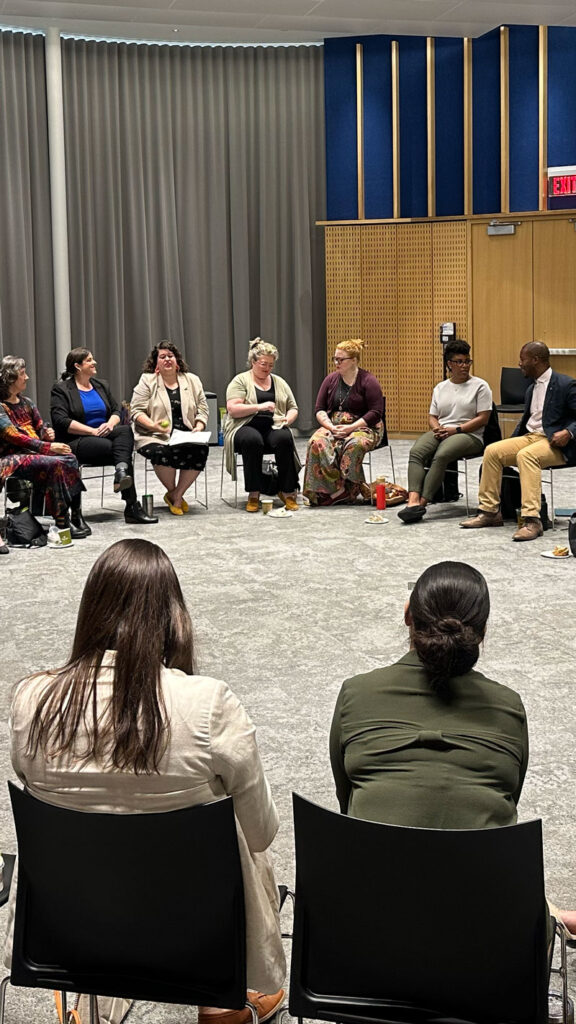
Community Building Sessions: Facilitated space(s) for staff and/or faculty members designed to help build community within a unit or department by providing tools to participants for developing compassion and understanding through intentional conversation and sharing.
Sessions Guided by Restorative Practices: Facilitated spaces/circles with staff and/or faculty members impacted by sexual and gender-based harm.
“Trainings provide the skills needed by all members of the academic community to identify and change behaviors, each of whom has a role to play in building a positive organizational climate.”
2018 NASEM Report – Sexual Harassment of Women: Climate, Culture, and Consequences in Academic Sciences, Engineering, and Medicine